Thursday, June 11, 2015

Keat's House in Rome


Was really thrilled to visit Keat's house in Rome. Byron and Shelley had also stayed there at some point. And I heard that Mary Shelley's Frankenstein was actually a result of a competition among them to write the scariest story. So incredible to be there, see the library and the view from the window and try and imagine the lives of these writers so many years ago.

Keat's Bedroom (he actually died here)

The library 

View from his window, would have been quite different while he lived.

Me feeling incredibly excited to be there.

Friday, January 20, 2012

Book Review: The Immortals of Meluha by Amish


So when I was in India this December I saw that Amish's books were on every best seller list. My curiosity was mostly aroused because it was based on Shiva. I am a sucker for mythology and love contemporary interpretations and fresh approaches to the myths and legends, that were a huge part of my childhood.

I think what was really disappointing was that the book was not well-written. There is a certain pleasure that one gleans from beautifully constructed sentences and intelligent writing. I think the actual story is interesting, but I wish it was better told. Also, the big "secrets" were really quite predictable and easy to guess. (even in the second book!)

The other thing that I had a problem with was the context of the setting. I enjoy fantasy and science fiction as genres and I also relish historical fiction. This book was neither here not there! Yes, it is set in ancient India but the world the characters inhabit is not true to that time period. Of course I understand the power of the imagination and artistic license. But this weird blend of using mythological characters in a historical setting, with a complete disregard for historical authenticity really irked me.

I have been reading a lot of historical fiction and some of my favorite authors, like Indu Sunderesan and Conn Iggulden, list the historical facts at the end of their books. These form the foundation on the basis of which they let their imagination soar, albeit after tremendous research. In The Immortals of Meluha, there was no such thing because I guess it is a work of fantasy. I understand the fact that he wanted to recreate the story of Shiva, as a man who became a God, because of his karma. I think that is an engaging concept. But why place him in the setting of ancient India, referring to historical events, without pertaining to any of the known facts of that era?


Yes, it is a  quick and entertaining read. I read it on my flight from India to the U.S. And I do want to know what happens to Shiva. I just wish that there was more to it, but there really isn't.


Sunday, January 8, 2012

Book Review: Sonia Faleiro's Beautiful Thing

Sonia Faleiro's Beautiful Thing is a work of non-fiction based on the lives and experiences of Bombay's bar dancers. Probably owing to the fact that Sonia Faleiro is a reporter, her voice as a narrator renders the Bombay dance bar world as is, without really letting her judgements color it. At the same time she is not just a detached observer. One can see the real friendships she forms, as well her thoughts and feelings regarding different people and scenarios but in a subtle way. Sonia is not over opinionated, nor condescending, nor does she over-sentimentalize the the Bombay dance bar world.

The book is really disturbing, more so because it is a work of non-fiction. What really struck me is the sense of false optimism that the bar girls adopt. They choose to keep themselves detached from the horror of their own plight in order to cope with it. Priya, a bar dancer, and her friend Poonam are raped my five men and she calls that night "Bhagwaan ki dua" (God's blessing) because another girl faced much worse. They accept the fickleness of the men who pretend to care for them, their lovers and "husbands," who exploit them, take their earnings and beat them. Priya says, "everyone drinks! everyone beats!" They are strong women, often smart and clever but they almost refuse to believe what they know to be true, with almost a warped sense of optimism.

The life of the bar dancers has its own set of rules which the girls are all familiar with and it gives them some  financial security even though it is rooted in their exploitation. But the girls feel that they are the ones who have the power over their "kustomers." Leela, the protagonist of the book, who is hedonistic and determined and easy to fall in love with says, "I don't dance for them, they dance for me."

Once the dance bars in Bombay are banned in September 2005, one sees the decline in the lives and fortunes of these girls and life becomes a struggle for survival, even far more grim.

The book is really sensitively written and is a riveting read but really disturbing. It is scary that numerous girls have been through this, and continue to go through it. It also offered a look into the lives of hijras (eunuchs) and the close connection between the hijras, bar dancers and the Bombay underworld.

I am really glad Sonia wrote this book. There are some stories that really need to be told. This was one of them.


Friday, January 6, 2012

Indu Sunderesan's The Shadow Princess

This book is set in the Mughal times and is a portrait of Jahanara, the daughter of emperor Shah Jahan who is famous for building the Taj Mahal, in memory of his wife Mumtaz Mahal. The book begins with the death of Mumtaz and the shift of her power and responsibilities to her daughter Jahanara, who is devoted to her father and supports him through his subequent depression and withdrawal from court life. The book is perfectly titled "The Shadow Princess" as the princess realizes that she and her sister will be forever shadowed by the memory of their mother. Even today, everyone remembers Mumtaz Mahal because of the Taj, the most beautiful monument ever made purely for love.

Jahanara and Shah Jahan (http://www.exoticindiaart.com)
The book offers an interesting glimpse into the politics of the Mughal court life. The young princes vie for the throne, trying to prove themselves to their father. The sisters have their own power struggle for the control of the zenana, and their love for the same courtier, Mirza Najabat Khan. Each pledges their loyalty to one of the brothers realizing that their power will be determined by whoever ascends the throne after their father. The women yield a different kind of power, shaping loyalties, veiled in secrecy and taking lovers.

The personal and the political clash in Jahanara's life as she strives to shoulder her responsibilities but has a secret liaison with Mirza Najabat Khan. There are also hints of an incestuous relationship with her father, though in the book they are accrued to a rumor started by her sister Roshanara, in order to ruin Jahanara's reputation. Even though she sacrifices much of her personal life, she makes some strong choices and retains her power and position despite the vacillations of court life.

The beautiful Taj Mahal
Parallel to her story is Shah Jahan's undertaking of building the Taj Mahal. Interestingly, his inspiration for the white tomb comes from the tomb Mehrunissa built for her father. (Mehrunissa, popularly known as Nur Jahan was his step mother and caused him to be exiled and hunted by his father till the time he seized power and banished her from his kingdom). It is ironic that despite his enmity with her, it was her idea and creativity that inspired the Taj which became a wonder of the world and immortalized Shah Jahan.

Overall the book is an engaging read. It is a political thriller, a love story, a portrait of the Mughal royal family and a wonderful piece of historical fiction. I highly recommend this book and will definitely be reading Indu Sunderesan's "The Twentieth Wife" which is based on the life of Nur Jahan.


Wednesday, January 4, 2012

2011 Reading

My goal for 2011 was to read a lot more. I think I succeeded in that, even though I failed the 100+ Book Challenge. I got to 44! (Still better than the twenty something books I read in 2010).

I also noticed that I picked up a lot of books that were between 600-800 pages because I just love long, lengthy novels that have a chance to really develop.

I absolutely loved the Gothic Reading Challenge and read many more than the 5 I had planned to read. Though I didn't pick up any works that were gruesome, I enjoyed the the dark undertones and well as the haunting quality of the books. I still prefer the Classic Gothic novels like Bram Stoker's Dracula and Mary Shelly's Frankenstein to the more Contemporary Gothic works, though I do have a soft spot for vampire fiction!

The other genre that I absolutely fell in love with was Historical Fiction. Again I had signed up to read 5 books but exceeded this number. I particularly enjoyed Conn Iggulden's Wolf of the Plains and am still in the midst of The Conqueror Series. The other book that really resonated with me with Irving Stone's The Agony and the Ecstacy. These books brought to life  historical eras and characters, rekindling my interest in history and drawing me into the fascinating world of the past.

The last challenge I had signed up for was the South Asian Reading Challenge at the expert level, hoping to read 15 books. I usually read a lot of South Asian writing but this year in my excitement to explore other genres, I ended up neglecting this challenge, reading only 6 books. My favorite of this challenge and also one of my favorites of the year was Indu Sunderesan's The Shadow Princess.

I also devoured fantasies this year, re-reading the Harry Potter series just as the last movie was released. I went on to read Terry Good kind's Sword of the Truth series which consisted of 11 books, one of the best reads this year. The other series I enjoyed was Christopher Paolin's Inheritance series, the last book of which I completed in the beginning of 2012.

All in all it was a fabulous reading year. For 2012 I decided not to sign up for any reading challenges. There are already a lot of books that I know I want to read. Besides that I will be looking at other bloggers' recommendations and explore new authors and genres and also read more books by the authors whose works I have grown to love.


Monday, December 26, 2011

Sabella Tsiopani's "The Perfect Peahen"

I recently came across some illustrations done by Sabella Tsiopani for her self-published children's book "The Perfect Peahen" on her blog. They are stunning! Vibrantly beautiful, poetic and just a visual treat. I love the bright colors, the geometric shapes and the textured quality of the illustrations. I hope to order the book soon even though it is a children's book.

I also love the fact that it is about a peahen, rather than a peacock. Besides the fact that I am a little bit biased towards the female sex, I also feel that peacocks always steal the glory!

These are three of my favorite images ( from her blog):


I really wanted to enlarge them so they filled my entire computer screen and just look at them!

Sunday, December 25, 2011

The Luxury of Book Stores

Browsing though book stores is something I have always taken for granted.

I can spend hours browsing, though it is always hard not to end up buying a few books. In California on weekend mornings (on the rare occasions I was not not teaching class) I would always go to the Barnes & Noble which was attached to a Starbucks. Then I'd walk with my coffee and look at the books that were on sale. Right across the street was Borders.

Recently all the Borders have shut down and I was horrified to discover that the Barnes shut down too. Yes you can order from Amazon but I really, terribly miss the experience of just walking though aisles of new books, the smell of fresh paper and the sound of rustling pages. Not to mention that if a new book comes out you can't go buy it that second!

So I am in Delhi right now and almost every market has a book store. Every time I go shopping, I slip into a book store. My favorites are Bahrisons in Khan Market and Full Circle in G.K. I also like going to Midlands in Aurobindo Market, while my mom runs errands. But basically every single market seems to have a book store. In fact, I went to watch a movie yesterday and I saw a small outlet of Spell &Bound, the new store in SDA market, INSIDE the movie theater! Isn't that awesome?

Basically I can't get enough of all the book stores in Delhi! It is just such a luxury! I am making the most of them while I am here, before I go back and forget what it feels like, once I am back in the Bay.


Monday, November 28, 2011

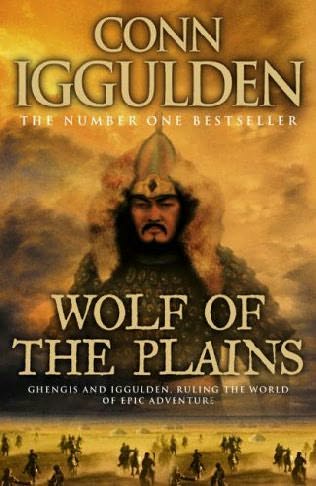
Book Review: Conn Iggulden's "Wolf of the Plains"


My friend Shreya recommended Conn Iggulden's The Emperor Series to read on the excruciatingly long flight from California to New Delhi, but owing to the fact that all the book stores near my home have closed down, I couldn't get my hand on the books. Anyways, I landed in Delhi and came home to find the first book from Conn Iggulden's The Conqueror Series, sitting on the shelf.

I read the book in a few days and it has been one of the best reads this year. As I started reading, I knew I was being plunged into an epic. The story of Genghis Khan, spans three books and Wolf of the Plains begins with his birth. Abandoned on the plains by his tribe after his father's death, with his brothers and mother, the book shows the determination of Genghis as a boy and his dream of becoming a Khan. It is a fascinating journey of his survival, his immense will and the forming of the vision of uniting all the tribes as a nation.

What makes this book really interesting is the character of Genghis. One sees him in his moments of complete despair and humiliation, and how they make him what he is. His bond to his father and how even as a child he has been taught to mask his fear by putting on a "cold face." His mother Hoelum is also a strong character. It is interesting how the women who are chosen to be wives are chosen on the basis of their strength and ability to bear children, rather than physical beauty.

Besides Genghis himself, one can actually visualize the other characters, the setting and the battles. The book transports you to the bitter cold of the plains where the tribes struggle for their mere survival and how they are ultimately and reluctantly forged into a nation. Conn Iggulden makes the characters and the action leap from the pages and capture one's imagination. It is historical fiction at it's best.

I can't wait to read the rest of the series and the continuation of Genghis Khan's journey as he goes on to become a legend!


Wednesday, September 21, 2011

Book Review: Joseph Sheridan Le Fanu's Carmilla

I have to say I really liked this book and finished it in a single sitting. I am fascinated by vampires and this book actually pre-dates Bram Stoker's Dracula. What was interesting was the fact that the main character was a female vampire who preyed on other women. I always thought that Dracula was the first book to explore this theme and the image of Count Dracula has captured the imagination of people for so long.

So it was really interesting to read about Carmilla, a countess preserved as a little girl who preys on other girls and women. There are overt references to lesbianism in Carmilla's love for the narrator. I just thought that it was kind of amazing that someone wrote this in the 1800's. In fact, the writer is a man, so his choice to make both the victims and the vampire women is really interesting.

I enjoy Gothic fiction, especially the old school variety. Most contemporary Gothic tales just don't excite me as much. The old Gothic novel's like Mary Shelley's Frankenstein, Charlotte Bronte's Jane Eyre and Bram Stoker's Dracula are just Classics that I can read and re-read.

Even though I won't put Carmilla in the same category as those Classics, I would still recommend it to anyone who enjoys Gothic fiction.


Monday, September 5, 2011

Dance Dance Dance by Haruki Murakami

Even though I love Murakami's style, how the metaphysical intrudes into everyday reality, how the ordinary becomes extraordinary, I have mixed feelings about this book.

My mother bought it for me because of the title, since I am a dancer. (not that the book is really about dancing!) When I started reading it, it sucked me in. But somehow by the end of it it did not resonate for me like some of his other books.

What I did enjoy was the satire of the novel and the air of mystery. The other side of reality part and the element of the bizarre which almost almost permeates Murakami's writings somehow just didn't work for me here.

I did for some reason really like the character of the teenage girl, who befriends the narrator after her famous mother "forgets" her in the Dolphin Hotel. The Dolphin Hotel which dominates the landscape of the novel really comes alive. It almost becomes a character in itself.

If you have not read any of Murakami's works, I would not suggest this novel to start with but if you have read his other works then, like me, you will find it captivating, an interesting mix of mystery, satire with generous sprinklings of the bizarre.


Monday, July 25, 2011

Book Review: Sword of the Truth series by Terry Goodkind

I am writing after a while since I wanted to finish the entire series before I wrote about it, which is 11 books. And then I just completely got lost in my dance world and have re-emerged after many months of being reading deprived!  Anyways these books were recommended by my friend Amit Patel and I really really loved the series. I was somewhat apprehensive when I began reading but the books are an engaging read. I love fantasy as a genre; nothing else allows such complete creative freedom. So wizards and confessors, mord-siths and all the characters and creatures are unique to this series, along  with the very landscape in which they are set.

The traditional good versus evil plot exists, but questions of what is right and wrong are raised. The books go beyond being fantasy stories, and it is the philosophy that emerges that unifies these books. Ideas of the value of individual effort are reminiscent of Ayn Rand's philosophy and her strong defense of capitalism. Thoughts of individuals taking responsibility and being active agents are hinted in the first few books and developed in the latter part of the series. The first book is called Wizards First Rule and each book reveals one of the rules of the wizards. Interestingly, these rules are not based on magic but are more practical and common sense, such as people will believe anything they want to, because they are afraid that it's true, and how sometimes the best intentions can create problems.

The characters are well-developed, my favorite being Richard Rahl and the mord-sith Cara. Emperor Jagang brings to mind Contemporary religious troubles. He genuinely believes he is doing the Creator's work, while his misguided actions create death and disharmony. His character echoes religious fanatics, who are single-minded in their cause and passionate about imposing their beliefs on others.

There were some books which were a bit tedious, my least favorite being "The Pillars of Creation" which dragged on forever and then just ended abruptly. I was also slightly bored by "Soul of the Fire." My favorites were "Faith of the Fallen" and the last three books of the series, just because they were exciting and action-packed!

So if you are a fantasy lover, this is one of the best series that I have read so far. I read these books a few months ago and was seriously considering re-reading them. But I figured I should read something new and maybe come back to these next year, though I must admit I am currently re-reading the Harry Potter series!


Thursday, May 5, 2011

Review: Percy Jackson & the Lighting Thief by Rick Riordan

I am a sucker for fantasy novels! And I love Greek mythology. I was quite apprehensive about this book and had been debating for a while whether I should get my hands on a copy.

The problem was that I had seen the movie. The movie was not bad, fairly entertaining. But I never seem to enjoy a book after I have watched the movie. Honestly, I don't even always enjoy movies based on books because most of them don't do justice to the written word. Still reading before watching is my preference.

Anyways I was at a friend's place eating dinner, when I happened to see this book. Her 9 yr old son was reading it which only made me more nervous that it would be too childish of a read.

But still something possessed me and I decided to read it. I don't know if I am just old school but I love myths and legends cloaked in the mist of the past. I somehow can't relate to concept of an Ares as a biker dude, Medusa in a burger joint or Mount Olympus existing on top of the Empire State Building. 

Anyhow, I didn't enjoy the book. Part of it definitely was that it was a bit childish for me. What I did like were the little mythological tidbits, woven throughout the fabric of the writing, such as the war between the Gods and the Titans and Persephone's story. But I do feel that the movie ruined it for me to a large extent.

I am actually going to attempt to read the second book. Maybe that will change my opinion. Maybe not!


Monday, April 25, 2011

From Native to Refugee (Book Review of Basharat Peer's 'Curfewed Nights' by Lado)

Guest post by Lado

With the promise of sweetened nimbu pani or fresh juice I trailed behind my friend Sam into the Cafe Turtle Bookshop. One has to enter the Bookshop to get to the cafe. I’m usually excited about books, bookstores, the smell of books, new books,old books, comics but we’d just gotten waxed and I wasn’t in the mood to browse.


My friend recently quit her job and was quite happy to be back in Delhi and kill some time. She pottered around unaware of my impatient nimbu pani dreams. After I’d gently put across some hints to hurry it along, I finally asked her if we could “get a move on?” to which she replied by whipping a book in front of my face “I had terrible nightmares for a month – Lado you HAVE to read this book!”.

Ouch.

I’m not too keen on Indian authors as I’ve found some of them tediously slow and melancholic (especially diaspora writers).
I always say “I live in Delhi and see it everyday – I don’t have to read 600 pages on India’s poverty.” All it makes me want to do is kill myself.
I’m a fast reader but suicidal is not a feeling I want to sustain for 600 pages.


In any case I wanted to hurry along and get that nimbu pani but there’s no point in reasoning with Sam- stubborn Tauruses! She doesn’t get that buying someone a book is like buying perfume – its great if you have the same taste but if you don’t it’s a gift that’s likely to be unused or re-wrapped. Anyway I decided the quickest way to my nimbu pani was to shut up and go along with it. I could always pretend later that I’d read the book.


Anyway having seated ourselves and consumed our summer beverages, Sam and I decided to verbal spar, which turned into us bickering and then maybe having gotten heated up from the hair removal and the wait, I took some very regrettable shots at her. In any case things cooled down eventually, we ate a plate of spicy-chilli-nachos.I apologized for being an ass, but there was no escaping that I’d hurt her feelings.

I got home later and found the book in my bag – there was no way even I could justify not reading the book now.


It was a couple of hours well-spent. The book was engrossing and I read it quickly over a couple of mornings.The title of the book is ‘Curfewed Nights’ and it’s by Basharat Peer and he tells of having to grow up in a changing Kashmir; A living through of the “Kashmir stereotype”, one that underwent a horrible change – idyllic apple orchards to raging modern battleground.


The writer has a style I enjoy, it’s to-the-point, descriptive without being tedious and he manages to balance emotion that he feels (it’s autobiographical) with the events that are happening. He’s also had his journalistic training so he manages to put significant political events in without getting statistical. Through his personal experience you can feel how someone could have a personal experience of a political event, or how society reacts and how community and families are immediately affected by overreaching events like civil struggle and war.

I have to say I like-hate the book. Like it because it’s so well written and suits it’s purpose; Mira Nair said in an interview “If you don’t tell your stories, who will?. He tells the story of adolescence affected by war in Kashmir and does it spectacularly. Hate it – because it’s heart-wrenchingly sad. Kind of how the story of Kashmir is.
It stays with me as a metaphor for the beautiful state, the story of any displaced people, refugees who dream of a home that no longer exists.

Friday, April 15, 2011

Review: One Amazing Thing by Chitra Banerjee Divakurni

Summary: In an Indian passport and visa office in an American city, an unexpected earthquake traps nine people within the premises. The characters include an upper-class Caucasian couple whose relationship is disintegrating. A punky teenager and her Chinese grandmother, with secrets in her past. A Muslim-American man, whose life changes post 9/11. A graduate student haunted by questions of love. An African-American soldier who seeks redemption. And two visa officers who are on the verge of having an affair. As food and water supplies dwindle, the basement is flooding and no escape seems possible, these people share personal stories; "one amazing thing" they have never shared before, from their lives.

Review: This book is easy to read and fairly quick. I liked certain elements in it such as the concept of sharing personal stories, as tragedy strikes this group of characters. Each of them is subtly transformed by this process of sharing.

The book is quite short (It is 220 pages, I usually steer towards the 700 page novels) but she manages to bring the characters to life through their stories, as well as their interactions with each other. Some of the stories are definitely more powerful than others, one of my favorite being Jiang's.  Her story was the first one and after that my expectations were set high, so I felt disappointed by some of the others. There were images in the book that were vivid and memorable, such as Lola's beauty salon, Jiang's shoe store and the description of the bits of food. Other stories were not as effective. I was waiting for the soldier-Cameron's story, but felt a bit let down when it was finally revealed.  Tariq and Mrs. Pritchett's  story were quite clichéd and didn't really strike a chord with me.

Overall, it was an OK book. There is no doubt that Chitra Banerjee Divakurni is a skilled story teller but there are other books by her that I have definitely enjoyed more such as The Palace of Illusions, or even Queen of Dreams. In comparison, this book is much more forgettable; I did not get a lot from it. It was reasonably enjoyable but not of those books that stay with you.

Tuesday, March 15, 2011

Review: Eats, Shoots and Leaves by Lynn Truss

I am not a big non-fiction reader. I happened to come across this book on my friend Jayanth's bookshelf and I just starting browsing through it. It caught my interest right away.

I do understand the importance of correct punctuation and value it deeply in my reading. However, I wouldn't call myself a "stickler" (The author is a "stickler!" There is a picture of her adding the required apostrophe to a poster of  the movie Two Weeks Notice, on the back, inside cover of the book). At the same time, I felt compelled to read this book.

How can a book on punctuation be fun? It can be informative, instructive, but fun? This book with the tag-line "The Zero-Tolerance Approach to Punctuation," was actually a fun read! It is amazing that a mundane (but important) topic like punctuation can become such an interesting read.

Besides the history and evolution of various punctuation marks, the differences between British and American punctuation styles, and the subtleties of the usage of punctuation marks, what I loved about this book was the author's style of writing.


Witty and sarcastic, providing hilarious examples as to how punctuation can change the entire meaning of a piece of writing, Lynne Truss's passion for the subject shines through. She explains that despite the rules, punctuation, much like writing itself, can be subjective, and has room for creativity. She renders what could have been a boring, dreary read, into a comic, creative and illuminating journey delving on the importance of correct punctuation and its frequent misuses.


Monday, March 7, 2011

Review: Her Fearful Symmetry by Audrey Niffenegger

Summary: Julia and Valentina Pool are twenty-real old twins, living in America, with no real interest in education or finding jobs. One day, they receive a letter informing them that they have inherited their aunt Elspeth has died of cancer, leaving to them her apartment in London. There are two conditions. They must live in it for one year before they sell it and that their parents can never enter the apartment. Elspeth was their Mother Eldie's estranged twin sister.
 They move to Elspeth's apartment, which borders Highgate Cemetery, where Karl Marx, Christina Rossetti and George Eliot are buried. In the apartment building, they meet Martin, who has an obsessive compulsive disorder, Robert, who was Elspeth's lover, and also the ghost of their aunt who still inhabits the apartment.

Review: I had mixed feelings about this book. There were parts of it that were enchanting, such as the description of Highgate Cemetery that emerges almost as an additional character. I also liked reading about the relationship between Martin and Marjake. But overall I can't say that I really enjoyed reading the book, despite the subtly of the emotional experience that it provides.

The whole twin relationship and the seeming loss of identity and the anxiety that characterized the Valentina-Julia relationship (and was suggested in the Elspeth-Edie relationship) seemed a bit clichéd to me. The aimlessness of the twins' lives also bothered me. All the characters were flawed and also quite quirky. I guess they did live next to a cemetery, but it made them less believeable.

The only relationship that I was sympathetic to was the Martin-Marjake relationship. Despite Matin's obsessiveness, he evoked the most empathy. Obsession becomes a recurring theme in the novel. There is the oppressive closeness of the twin sisters, Robert and Elspeth's frantic communication after her death, and his own obsession with the cemetery, so that his thesis is thousands of pages.

The book has dark undertones which become more vivid as it progresses. It is hard to talk about a lot of the ideas, without spoiling it for people who haven't read it. It is like a Victorian ghost story set in Contemporary times. I personally prefer the old school Gothic writing. A ghost writing "LOL" on an Ouija board is really not palatable for me.

It is a gripping book though, that is hard to put down. The story is developed nicely and keeps one engaged. One really gets a sense of the personalities of each of the characters. (Though for me, getting to know them really made me dislike a lot of them!) I would recommend it just for the description of Churchgate, the subtlety of the text and the haunting quality that seeps through the book. But I had been wanting to read it for a long time and was quite disappointed.


Monday, February 28, 2011

Review: "The Agony and the Ecstacy" by Irving Stone

Summary: A biographical novel based on the life of the great artist Michelangelo. It is based in the Renaissance times —the powerful Medici family, the monk Savonarola, and the political turmoil which in intrinsically linked with his art making. The novel begins in his childhood when he begins his first apprenticeship and ends with his death when he is almost ninety, spanning the years where he is possessed with the fury of making magnificent art.

Review: This epic novel was brilliant and inspiring. It brought to life the turbulent Renaissance times and the genius of Michelangelo. His need to create art pervaded the book. The longing which he felt to carve stone, superseded any other emotional attachment in his life. My favorite parts were the descriptions of his state of mind as he conceptualized new sculptures or paintings. He put so much thought even into the traditional and mythical figures like Mary, David, Hercules and Christ, figuring out which stage of life he wanted to reveal them in, what they were to signify and how to best achieve that.

David
His obsession with his art, was juxtaposed by the difficult scenarios he found himself in, where he was forced to stay away from that what he loved. Even as fame came to him, the Popes wanted him to create works to immortalize them, in the process drawing him away from that which drove him. He became a pawn in the political struggles that scarred the landscape of Italy. But even as he created works that he was compelled to do, he was unable to to do them in a mediocre way. He had to do them to the best of his ability, disregarding money, food and even sleep. I was fascinated to learn that the Sistine Chapel ceiling which he is famous for, was also a commission which dismayed him, as it kept him away from marble carving. His greatest love was for marble carving and the language of the book, in the description of the process of selecting, carving and even describing the marble, portays this beautifully.

It was interesting to see his relationship with other artists, especially Leaonardo Da Vinci and Raphael, two other famous artists of this period. In terms of the women in his life, only his relationship with his first love, Contessina, Lorenzo de Medici's daughter, stayed with me. His relationship with his family was difficult to read about. His father's lack of interest in his art and only in the money it brought is not surprising but frustrating.  

Sistine Chapel
Even though it was absorbing, the book was a slow read. I felt that his sense of purposelessness when he was not involved in creating art, coincided with the slowing down of the narrative. And when he was engrossed in making new works, the pages rushed by. This was my personal experience, probably because I  really enjoyed reading about his art-making. It was heart-breaking when the arm of his David broke due to a mob of fighting people. It makes one realize how ephemeral art can be. It took him years and years to create some of these works and they could be destroyed so easily. His bronze statue of one Pope was melted and made into a cannon, with the change in power structure. I actually felt anxious when there were discussions of painting over his Sistine Chapel painting as people thought it "ungodly."

Tomb of Julius II
Besides the actual process of art making, there was this fury to create art that pervaded the entire text, which I found captivating. He was so in love with his work that he dismissed any practical and logical thoughts, doing whatever he could to get his hands on marble. He was driven by bringing his own unique interpretation to his art, in a time where staying true to convention was revered in artists. He actually performed dissections, something he could have been hanged for, because he felt he must understand the inner workings of the body in order to display them in art. He defied a Pope, questioned all authority and challenged the best artists of his time. At the same time, he doesn't come across as a vain person, just someone who was solely consumed by his passion for his art.


Pieta 
I think everyone should read this book to understand the trials and tribulations one of the greatest artist ever, faced in his lifetime. The book is perfectly titled "The Agony and the Ecstacy" because it is marked by these extreme emotions. It is a fascinating read about the Renaissance times, the power struggles, the questions of faith and most of all the genius of Michelangelo.


Wednesday, February 16, 2011

Review of Sarah Dunant's 'The Birth of Venus'


Summary: Alessandra Cecchi is a girl born during the Renaissance times, who is passionate about painting, not really a viable option for women in that era. When her father brings home a young painter to their house to decorate the chapel walls in the family's Florence Palazzo, she is drawn to him. But she is eventually married to a wealthy, older man.
Her story is in the foreground of Italy during the Renaissance times. There is the Medici family, patrons of the arts and learning. Challenging their power is the fundamentalist monk Savonarola. As life in Florence changes drastically, Alessandra once again has the opportunity to paint, and to love.

Review: I enjoyed reading this book. It vividly brought to life Florence during the Renaissance times. The historical framework was really exciting but it was the character of Alessandra that stayed with me. Rebellious by nature, drawn to life outside of her home and hearth, and a talented painter, it is difficult not to fall in love with her character. She chooses marriage to a wealthy, older man, only because it would help her escape life in a convent. She challenges conventions and stretches the limited options available to her, as a woman of that era.

She vocalizes her thoughts that there were no women artists during that time, because women did not have the access to learning, apprenticeships and the other opportunities that the men had, to improve their skills. Still, with her limited access to resources, she manages to paint. 

Her life becomes the foreground and in the background is the political turmoil in Florence. Questions of faith stem up as religion becomes a political tool (not much different from the state of the world today!) There are references to the beginning of dissection by artists to understand the inner working of the body, in order to reflect that in their work. This is of course a huge taboo. The other taboo is homosexual relationships, and the fate of the people accused is horrific.   

Overall, it is an engaging read, rich in detail but without being tedious. The history and personal lives of the characters intersect so that the personal becomes political and vica versa. I am excited to read the other books in Dunant's Italian Trilogy.


Monday, January 31, 2011

Book Review: A.S. Byatt's "The Children's Book"

Summary (from the back cover of the book): Famous author Olive Wellwood writes a special private book, bound in different colors, for each of her children. In their rambling house hear Romney March they play in a story-book world — but their lives, and those of their rich cousins and their friends, the son and daughter of a curator at the new Victoria and Albert Museum, are already inscribed with mystery. Each family carries their own secrets.

They grow up in the golden summers of Edwardian times, but as the sons rebel against their parents and the girls dream of independent futures, they are unaware that in the darkness ahead they will be betrayed unintentionally by the adults who love them.

Review: It is difficult to review this book as the writing is extremely dense and it has so many interesting nuances. I read it a few weeks ago but there are parts of it that I am still thinking about. The book is set in the Edwardian times and I love the description of the artistic, cultural and political milieu. I especially like the contrast  between the artistic environments of England and Germany and the sprinkling of real facts, events and people, within the fictional world. They provide a rich framework of reference, within which Byatt's characters interact. 

The characters themselves are varied, some more memorable than the others. Olive Wellwood and Benedict Fludd, offer two different views of artists consumed by their art. Olive's residence, Todefright, stands in sharp contrast to the gloomy environment of Fludd's Purchase House. However, despite the differences in their personalities and their approaches to their respective arts, they both become the agents of tragedies, because of their artistic obsessions. There is an alternative offered to their tendency towards self-destruction and that is seen in the life of the German puppeteer Anselm Stern, who despite his eccentricities is able to find a balance between art and life. 

Initially Olive's world seems almost ideal. It echoes the pastoral life, even though it is clear that her husband Humphry's financial position, offers them this lifestyle. This couple is almost the antithesis of Humphry's brother, Basil, and his wife, Katherina Wellwood, and it is interesting how at the end of the book, after the destructive war, it is their home that becomes the focal point, a shadow of Todefright in it's glorious days. The physical spaces described in the book reflect and affect the personalities of those who inhabit them. The tree house becomes the everlasting symbol of the Wellwood childrens' childhood. Its destruction prefigures Tom's tragedy. For me, Tom is the single most memorable character and also the most tragic. With his inability to relate to the realities of the world, he almost becomes a part of the fiction that his mother creates for him, and is ultimately doomed because of that.

Olive Wellwood's stories, even though written for children have a dark and disturbing edge. The prince who's shadow is stolen by a rat and the girl who captures tiny people, to be captured by giant people herself, are children's tales with adult themes. They dot the landscape of the writing, and are intriguing.

In terms of the women characters, Dorothy, who follows the difficult path of becoming a doctor, stands out. Elsie, too emerges as a strong character. It is interesting that the women who seek to pursue life beyond the household, are able to find happiness in work and in their personal lives. The women who are more traditional, content to be homemakers, seem to find no contentment. Phyllis, the only Wellwood girl, who only wants to be a homemaker and a mother, is unable to achieve even that, and fades into the background, much like her mother.

The book explores themes of parenting, responsibility, freedom of choice, the city versus the country and sexual freedom, among others. It is a compelling read, but not a simple read. I was immersed into it quite quickly, but it needs to be read at leisure. It is not a book to be read in a few quick sittings. Much like Possession, which I also loved, maybe more so because of the poetry in it (I am partial to poetry!), this is a book that one needs to chew on. As for me, I think Byatt is becoming one of my favorite writers; I will definitely be reading more of her work.



Saturday, January 22, 2011

Book Review: "Funny in Farsi" by Firoozeh Dumas

Summary: A memoir of a Iranian girl who migrates to America when she is eight years old. It is a humorous account of her experiences of growing up in America.

Book Review: I really enjoyed the lightheartedness of this book, the conversational tone and the simple language. It strung together Firoozeh's different experiences, being an immigrant from Iran in America. A lot of writing on the immigrant experience is preoccupied with the nostalgia for the homeland and the hardships of understanding a new culture. Even though this book did discuss the process of adjustment, it was permeated by a sense of innocence that made it refreshing.

The book, which is a memoir, is humorous. Firoozeh is able to laugh at herself and her family without demeaning them or her culture. Even though there is a sense of wonder about America, it is not blind, and she is able recognize the shortcomings of the culture, just as she can see the good and the bad in her own culture. I really liked the lack of bitterness in her tone, even as  she discussed important issues, such as being discriminated against for being Iranian, after the incident where several Americans were taken as hostages in Iran.

 In Firoozeh, one sees the intermingling of both the Iranian and American cultures. There is no pining for an idyllic Iran and no blind devotion to a perfect America. The ease of the writing and the honesty of tone makes it a delightful read. It is a quick read, that one can finish in one sitting.